Friday, January 15, 2010

Geothermal Pitches Wall Street

Representatives of the Geothermal Energy Association had their largest schmooze-fest ever in New York Thursday (Jan. 14). They met with Wall Street financiers, had lunch with politicians, including Senate Majority Leader Harry Reid (D-NV), Mayor Bloomberg declared “New York City Geothermal Energy Day”, and at the end of the day they even got to ring the closing bell on the stock exchange - well, on the smaller and less prestigious NASDAQ, but it’s still an honor.


Will Geothermal always remain the poor cousin of the better-established solar and wind industries?

The New York Times reports:

Overall, advocates say, geothermal technology is proven and has distinct advantages over wind and solar. Geothermal power is a steady and reliable baseload, which electric utilities appreciate. And geothermal plants use less land than wind farms or solar arrays.

But [the GEA Executive Director Karl] Gawell admits major Wall Street investment banks shy away from geothermal because it takes years to see a return on investments. A Nevada project that came online last year took five years to complete, compared with a lead time of little more than a year for a standard wind farm.

“They’re realizing that geothermal can be a good investment,” Gawell said. “You’ve just got to stay in there a little bit longer.”

Gawall also stopped in at the Wall Street Journal to pitch them on earth power, noting that 200 megawatts have come online in the past year.

“It’s being rediscovered in the U.S.,” Mr. Gawell says. While the U.S. is currently the world leader, the geothermal industry today is where the wind-power industry was 20 or 30 years ago, he says.

And given the role that big corporates—such as General Electric and Siemens—played in the explosion of the wind industry, the logical question is, when will big companies pile into geothermal? GE has been showing up at geothermal meetings lately, Mr. Gawell says, and GE Energy Financial Services finances some geothermal investments.

Analyst Byron King says it’s time the big companies jumped in and took over from the “mom and pop” operations. In his Energy & Scarcity Investor (via BeforeItsNews.com), he says:

The pre-crash business model of the geothermal industry is no longer appropriate to the tight-credit world in which we live… Post-crash, it’s clear that most publicly traded geothermal companies are too small. Back when credit was cheap, money flowed more easily and you could “afford” to be patient over a five-to-eight-year time frame. The same small team of developers was prospecting, leasing, drilling, finding, assessing, fundraising, developing, building, stringing electric line and selling power. Holy smokes, Batman! Where’s the point where we can MONETIZE this?

But in our new economic world, the small, mom and pop business approach just won’t cut it. Geothermal power takes too much upfront capital to make things work. It requires too many different management skill sets. Like many things in life, bigger is better with geothermal. In fact, the world’s largest geothermal producer is Chevron Corp. Is that big enough?

At least some of the investors are excited:

By 2012, “we think the strategic landscape starts to change quickly,” said Paul Leggett, a vice president of investment banking at Morgan Stanley. “We do think the geothermal industry is ready for a takeoff.”


(Originally appeared at Tenthmil.com)

Thursday, January 14, 2010

Deforestation: Avatar, Vietnam, and the War on the Trees

(Originally appeared at Tenthmil.com)

One thing the blockbuster film “Avatar” showed in glorious, graphic 3D: In war, no matter who wins, the forest nearly always loses.

There goes the neighborhood

In the normal course of life, average folks tend to be conservationists. Why shouldn’t they? Just like the Na’vi of “Avatar”, most human societies throughout history developed systems that enabled people to live on the same patch of ground for generations.

The Bible actually commands: “When thou shalt besiege a city a long time, in making war… thou shalt not destroy the trees thereof by forcing an axe against them.” This was also the norm in the intercity warfare of classical Greece; The Spartans only cut down Athenian olive trees when their enmity became really nasty. 

Trees are part of that stability, whether it’s olive and fruit trees for food, or other species for lumber, shade, and cover. You plant trees for yourself, and for your children and grandchildren.

 Today we call that “sustainability.”

But in times of war, the timeframe changes: people do what it takes to survive this year, this month, this day. If that meant cutting down a forest, then the forest came down, regardless of the effect it would have on future generations.

 And indeed, that’s what happened as empires arose in the ancient and classical world. First, warfare devastated Mesopotamia – the deserts of Iraq were once rich farmlands, and the brown hills once were covered in forests.

Then the Greeks and Romans waged their wars, and the tree-cutting spread throughout the Mediterranean. Forests came down to build siege engines, for army cookfires, and sometimes to punish enemies.

The war on the forest

But Caesar cut down Gallic forests to prevent his enemies using them for cover; Augustus did the same on the German frontier. That set the stage for the next thousand years of warfare – Henri II of England set fire to the forests of Ireland for the same reason.

And it wasn’t just the forests of the enemy that were decimated. The Phoenicians wiped out their own resource, the storied cedars of Lebanon, to build their fleets. The forests of Spain were leveled to build King Phillip’s Armada; then France’s forests were cut down for ships, and so were England’s – it’s estimated that when Nelson battle Napoleon’s fleet at Trafalgar, each of his ships had taken about 6,000 mature oaks.

In the modern era, third-world conflicts are often financed by timber sales. The Khmer Rouge Communist insurgency in Cambodia was financed by rainforest destruction; that has since happened in Papua New Guinea, Indonesia, Indochina, Myanmar, Sri Lanka, Central Africa, the Amazon, Colombia, Central America, and New Caledonia.

Wars also create refugees, desperate people struggling to survive far from their native region. Without a stake in the local ecology, and with life and death on the line on a daily basis, they strip the region of food and firewood. During the Rwanda conflict, refugees nearly drove the mountain gorillas to extinction. In the Congo, it was elephants that were nearly destroyed.

And in many cases, ecological destruction leads to war and conflict that in turn leads to more ecological destruction. In Darfur, it was deforestation that led to scarcity, conflict, drought, and a huge refugee crisis… which in turn led to more deforestation and desertification.

We keep pushing the envelope.

The tree-destruction scene in “Avatar” looked like something out of the Vietnam War, for good reason.

In Vietnam, the American Army had Caesar’s problem: the enemy used the forest for cover. But they had a whole new way of dealing with it: Napalm to burn them out, and Agent Orange to defoliate. The jungles of Southeast Asia couldn’t fight back like “Avatar’s” Eywa, and took years to recover. The toxic side effects took their toll on the local ecosystem, as well as the local people, and also the American soldiers who were exposed.

When Saddam Hussein’s army pulled out of Kuwait during the first Gulf War, they set fire to the oilfields, creating a whole new kind of environmental devastation. During the most recent Lebanon conflict, Israel bombed a major coastal oil facility, staining 80 miles of coastline with 110,000 barrels of oil. At the same time, Hezbollah rockets fired into Northern Israel set off forest fires, destroying an estimated 600,000 trees.

But there actually is a bright side…

After Gulf War II, the US restored the marshlands of Southern Iraq, bringing back a habitat of 7,000 square miles (twice the size of Rhode Island) that had been turned to desert by Sadam Hussein in retaliation for an uprising of Shia Arabs.

During the Guatemalan Civil War, the Peten District became such a dangerous place (more than 100,000 people were killed) that tree-cutting effectively ended, leaving it today as one of the largest surviving stands of virgin tropical rainforest north of the Amazon.

There’s an international movement to create peace parks along international borders that have suffered ecological upheavals, such as the eastern Congo.

And there’s the Korean Demilitarized Zone.

Picture a pristine environment.

Forests of Mongolian Oaks full of birds; streams full of fish; coastlands with rare birds like Manchurian Cranes and Siberian Herons. Endangered species like the sak wildcat and the Asiatic black bear.

And no people – no people at all.

The Korean DMZ is a narrow ribbon of land 150 miles long and two and a half miles wide. The DMZ was created in 1953 at the end of the Korean War to keep the two Koreas, North and South, from shooting each other.

For more than 50 years, thousands of nervous, trigger-happy troops patrolled along the DMZ, but never ventured across the barricades and barbed wire. And so, inadvertently, it became a refuge. As Korea industrialized, its population boomed and its industry drove countless species into decline and extinction, the DMZ remained untouched.

Not quite as lush as Pandora, the zone still manages to cover an amazing range of environments, including wetlands, forests, estuaries, mountains, coastal islands, and riparian valleys. Waterfowl love it – it’s the wintering ground for two of the world’s most endangered birds, the white-naped crane and the red-crowned crane.

Still waiting for formal protection, the biggest threat to this accidental preserve would be peace. With the South Korean capital, Seoul, just 20 miles to the south, there will be heavy pressure to develop the region for condos and office parks if there is ever a peace treaty between the North and the South.

Perhaps the local waterfowl and small animals are secretly praying for us crazy humans to stay at war with each other….

All images copyright 2009 Twentieth Century Fox Film Corporation

Tuesday, January 12, 2010

Biomass or Biomess?

One of the things we should have learned from the corn to bio-ethanol mess of the past five years is: haste makes waste.

The subsidies that were supposed to help create a sustainable industry and help small farmers instead turned into a massive hand-out to big agriculture, and drove up prices on corn and other food when it was diverted to fuel - and the socalled green bioethanol turned out to cost almost as much CO2 as fossil fuels.

Now, the Washington Post reports the same thing is happening with wood biomass. Subsidies that were supposed to create green fuel are instead warping the market:

In a matter of months, the Biomass Crop Assistance Program—a small provision tucked into the 2008 farm bill—has mushroomed into a half-a-billion dollar subsidy that is funneling taxpayer dollars to sawmills and lumber wholesalers, encouraging them to sell their waste to be converted into high-tech biofuels. In doing so, it is shutting off the supply of cheap timber byproducts to the nation’s composite wood manufacturers, who make panels for home entertainment centers and kitchen cabinets.

Of course, subsidies are an important tool for jump-starting the green economy. But not the way the wood biomass subsidies were written.

Biomass energy representatives, such as the Biomass Power Association president, Bob Cleaves, said those subsidies are critical to support a sector that currently supplies half of the nation’s renewable energy (the other half coming from wind, solar and other sources). Seven of Maine’s 10 biomass energy plants would have shut down without the new influx of funds, he said.

“The industry needs help,” Cleaves said. “Is the country not prepared to spend half a billion dollars on half the country’s renewable energy resources?”

The Agriculture Department, for its part, says it has no choice but to implement the subsidy the way Congress envisioned it under the 2008 farm bill. That legislation made no distinction between a waste product with little market value, such as corn husks, and the sawdust that sells for roughly $45 a dry ton.

Senator Tom Harkin (D-IA) is looking into the problem, and so is the Office of Management and Budget. So hopefully that means we’ll be seeing this fixed fairly quickly. Everyone agrees that some form of subsidy for biofuels is a very good thing - when it encourages the market in the right way.

But pellet mill owners such as the Rolf Anderson, chief executive of Bear Mountain Forest Products, said the program will eventually create an incentive for people to bring small pieces of wood left by loggers out of the forest, which will give companies like his a cheap and steady stream of raw materials.

“It opens up economic opportunities. It opens up healthier forests, and it helps companies and individuals save on their energy costs,” said Anderson, whose company is based in Oregon.

The problem with subsidies, though, is once companies start getting millions of dollars from the public trough, they lobby hard to keep the flow coming. Why? Because companies can easily afford to donate tens of thousands of dollars to campaign coffers if it means millions of dollars in government funding. The 2008 Farm Bill that contained this biomass provision was widely derided as a bloated mess that ended up pouring billions into Big Ag without really helping out struggling farmers.

What can you do? Write your Senators and Representatives and tell them to get it right.

(Originally appeared at TenthMil.com)

Friday, December 04, 2009

Informed Comment Is More Useful Than Spin and Fingerpointing

Hey, guess what? Science is hard, but it's easy to take a few sentences out of context to make people look bad.

Canada's Elizabeth May actually read the stolen/hacked East Anglia climate emails - all 3,000 of them. And what she found was, in her words "We've been had."
"Starting from 1996, these good and decent scientists write to each other... Tough stuff using proxy records to figure out what the temperature was... They wrote each other sharing ideas for handling the records from tree rings. They struggled with how to re-calibrate surface sea temperature records. This was a neat thread. Turns out those navies around the world kept records of the temperature of the sea water before using it in the steam room engines. The temperature records shifted when they stopped using wooden buckets and moved to canvas buckets. Tough work evening out the temperatures so they are comparable."
Not very glamorous or exciting, but important work. And very easy for ignorant people to point the finger and say: "You're changing the data!"

Tuesday, November 10, 2009

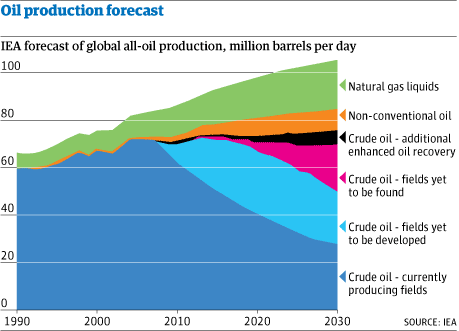
US (=Bush) Pressured IEA to Inflate Oil Reserve Numbers


Did the International Energy Agency inflate oil reserve figures to make it look like we're not facing peak oil?

That's what the Guardian is reporting, based on statements by a whistleblower:
The senior official claims the US has played an influential role in encouraging the watchdog to underplay the rate of decline from existing oil fields while overplaying the chances of finding new reserves.

The allegations raise serious questions about the accuracy of the organisation's latest World Energy Outlook on oil demand and supply to be published tomorrow – which is used by the British and many other governments to help guide their wider energy and climate change policies.

...Now the "peak oil" theory is gaining support at the heart of the global energy establishment. "The IEA in 2005 was predicting oil supplies could rise as high as 120m barrels a day by 2030 although it was forced to reduce this gradually to 116m and then 105m last year," said the IEA source, who was unwilling to be identified for fear of reprisals inside the industry. "The 120m figure always was nonsense but even today's number is much higher than can be justified and the IEA knows this....
Read the whole thing...

Monday, October 12, 2009

Glen Hansard and Damien Rice Busking for Oxfam!

This is fun... and important. It's so great when folks use their star power to bring more people into the green movement...

Tuesday, October 06, 2009

Do it for the Planet.


Coming up on October 15.... sign up and do your part, too!

Coal Is Too Dirty... :)


I didn't realize that some college campuses have their own coal-fired power plants. Time for a change....

Friday, August 14, 2009

Sunday, April 19, 2009

Good point - health insurance is different

Great analysis of the fundamental problem with our current health insurance system:
Insurance only works at all because of pooled risk - you pay into a general pool and insurance companies are able to calculate the statistical likelihood that they'll have to pay out in case of accident. "Accident" is the key word - it's an event that has some probability of occurring given someone's history and lifestyle. But it's a finite, time-limited occurrence that incurs a certain amount of cost. Car insurance, therefore, works. Yes, you pay more if you're a poor driver or a 16 year-old, but there's still some statistical probability that these people won't get into accidents. Health care isn't like that. If health care insurance companies were only hedging against the likelihood that someone will slip and fall and break an arm, or fall off the ski lift, then the private solution would work fine. Now imagine the following case. To continue with the car insurance analogy, pretend that everyone has one car that cannot be sold. Some people have lemon cars whose brakes fail every week, or have continuous oil leaks, etc. In other words, the insurance company knows that it will have to pay out on the people with lemon cars, not just occasionally, but continuously. There's absolutely no incentive to insure these people at all. We could, as a society, say well, that's tough. Only, eventually, we all end up with lemon cars - we're all going to die one day, and the large majority of us will be sick for some time before that. The only way to insure people with lemon cars is stick them in a large group of average people and calculate the risk for that pool as a whole.

Friday, February 20, 2009

Wanna print some green money?

Okay, you and I can't crank out the billions the way the big boys do in Washington.

But if you're a fan of Seventh Generation cleaning products, you'll be pleased to know they now have $1-off coupons on their website.

In these times, every little bit helps....

Friday, November 28, 2008

Important note: Foodies can't be Dummies

Please try to keep in mind as you shop this holiday season: Fair Trade doesn't just apply to African villagers and Amazon tribes - it also applies to the folks who grow our food here at home.

An interesting note from a farmer who tried switching from big-breasted flightless corporate turkeys to heritage birds:
Our customers who had eagerly signed up to reserve a heritage bird were not only disappointed about the size, but they also complained about the higher price tag and the noticeable lack of breast meat. So the heritage birds cost 2.5 times the price as chicks, took twice as long to grow out, ate nearly twice the food, and dressed out at half the size. We had to charge $8/lb. and we still made no profits on these birds. What was curiously frustrating was that these self-described foodies still wanted the size and body shape of a hybrid bird, along with a small price tag. Even somebody from a local Slow Food chapter still insists that we should be able to raise heritage turkeys for $4/lb.
That's right. Real food costs more, and doesn't look the same was as crap corporate food (or taste the same way, thank god!)

I've also got a post up over at Ecoble.com about how to live a little greener on Thanksgiving this year... check it out.

Thursday, November 27, 2008

Whining about Wine


What is it with some people and wine?

Nobody would argue that Hershey's chocolate is better than Dagoba or Ghirardelli, or that there's no difference in quality between a Mercedes and a Mercury.

And yet, when it comes to wine, it seems every six months someone is trotting out "evidence" that there's really no difference between higher-priced bottles of wine and the cheap stuff. That it's all about elitism and marketing and hype.

When I was first learning about wine, I bought into it, too. I'd tried $6 bottles and $16 bottles, and there didn't seem to be that much difference. So why spend the extra $10?

Then I did a write-up on the Hermitage Inn in Wilmington, Vermont, and got a chance to sample from its 30,0000-bottle cellar. My first $40 bottle of wine, from California's Far Niente vineyard. Wow! Here was a wine that outshone the hype. It was complex, light, dazzling... and totally worth the price.

I still buy cheaper wines (who can afford $40 a week on wine, in this economy?), but I totally lost sympathy for the elitism/marketing whiners.

Like Robin Goldstein. His study, which "proved" that most people couldn't tell the good stuff from the cheap stuff in blind taste tests, made the rounds this past spring (here and here), and is cropping up again. Jonah Lehrer, at The Frontal Cortex, just brought it up, and Andrew Sullivan picked up on it too. Both of them pushed the line that, in Lehrer's words, "expensive wine doesn't necessarily taste better, at least for people who aren't wine experts".

This kind of "study" always bugs me, so I tend to delve into the raw numbers to see where they're pulling their conclusions from. And guess what?
To make sure that our results are not driven by wines at the extreme ends of the price distribution, we also run our regressions on a reduced sample, omitting the top and bottom deciles of the price distribution. Given the broad range of prices in the sample, this is an appropriate precaution. The remaining wines range in price from $6 to $15.
Meaning: 90% of their wines are priced at less than $15. What elitism? The useful comparison is between the $10 bottle and the $40 bottle, not between the $6 bottle and the $15 bottle.

So what's the real scoop? Goldstein was publishing a book: "The Wine Trials: Brown-bag blind tastings reveal the surprising wine values under $15." That certainly explains the fact that 90 percent of the study's wines were under $15.

Their choices of more expensive wines? Mere foils, so they could say things like:
"...when more than 500 blind tasters around the country sampled 6,000 glasses of wine ranging in price from $1.50 to $150, their preferences were inversely correlated with price. For example, Domaine Ste. Michelle, a $12 sparkling wine from Washington State, outscored Dom Pérignon, a $150 Champagne, while a six-dollar Vinho Verde from Portugal beat out a $40 California Chardonnay and a $50 1er Cru white Burgundy."

The book is a nice idea. There are a lot decent wines out there for under $15, and a guide is a great thing (see here for another good source of tips). But it's just not a source of accurate scientific data.

And yet they managed to market their 'findings' into the pages of Newsweek and the New York Times... while pontificating on the notion that much of wine snobbery was nothing but marketing. Ah, the irony..

Tuesday, November 25, 2008

Think Green This Thanksgiving

All we have to do this year is look toward Washington, DC, and we've got tons of stuff to be thankful for...

But as we officially enter the season of holiday cheer, holiday shopping and holiday excess, can we all think about the planet, too?

They say that green is the new black, but that doesn't mean you have to get all emo about it. It's possible to be joyful and celebratory - and smart.

10 Great Ways to Green your Thanksgiving

Getting There - Thanksgiving is one of the heaviest travel weekends of the year, and how you choose to get there can make a big difference in your annual carbon footprint. If you’re driving long distances, avoid SUVs and big gas-guzzlers – remember, you can always rent something smaller. Carpooling is also good, although not always an option. And if you’re flying, keep in mind that air miles are about the most damaging mode of travel for the environment. Avoid flying if possible; if you can’t, consider purchasingcarbon offsets from a reliable source.

Set the Scene - Candles are great for creating a warm, homey environment. But paraffin candles are awful for the home environment. They’re made from petrochemicals, they put vaporized parrafin into the air, and they often contain artificial oils and scents that you don’t want your loved ones to be breathing, either. Today, we have better options, made with beeswax and soy wax. Likewise, as you’re buying decorations, think of what’s going to happen to them when the holiday has passed. Try to avoid buying a bunch of paper goods that will go straight into the landfill.

Moderate the Meat - Industrial agricultural poultry farms generate a huge amount of waste; too much to compost (which is how small farms deal with natural by-products in a natural way, returning them to the soil as fertilizer). Instead, all that manure degrades into methane – a greenhouse gas that’s 20 times more potent than CO2. Plus, these birds are pumped full of antibiotics and nasty chemicals to try to keep them healthy in that cramped, hellish environment. This does awful things for the meat – both in terms of nutrients, and in flavor. Go for a free-range organic bird – your taste buds will thank you, as will your arteries. (Or you could try going Vegan…)

Go Local - Transportation is a big part of the CO2 impact of our food. Shipping by water has a modest impact, trucking is pretty bad, and air freight is terrible. Which means that, surprisingly, (ocean-shipped) Peruvian mangoes may have a lower impact than (trucked) Idaho potatoes. Your best bet – buy local. Go down to the farmers market for the most planet-friendly potatoes and yams.

Go Seasonal - Hothouse-grown peppers, tomatoes and lettuce are also not great for the environment – because of the hefty energy used in growing them in cold climates. Think like the Pilgrims, and try to focus on things that grow naturally in your neighborhood this time of year. In the north, that might mean substituting cold-loving crops like spinach, kale and chard instead of a salad.

Go Organic - Industrial agriculature depletes the soil, then uses petrochemical-derived fertilizers to attempt to replenish it. It’s a crazy system that’s accelerating climate change. Organic agriculture, in contrast, actually returns large amounts of carbon to the soil. If all the farms in the US switched to organics, it would be the equivalent of taking millions of cars off the road! Plus, organics are healthier. And your health is always something to be thankful for.

Avoid Packaged Foods - Often, producing and disposing of food packaging takes more energy than it took to grow and process the food in the first place. What can you do about that? Cut back on pre-packaged stuff. Go with fresh local spinach instead of frozen; bake your own pumpkin pie instead of buying one in a plastic clamshell from the market.

Recycle - And of course, make sure the cans, bottles, and packaging you use gets recycled.

Compost - Don’t send your scraps off to a landfill! In that nasty environment, food waste breaks down into methane, which as we’ve noted is a greenhouse gas 20 times more potent than CO2. Set up a home composting system; if you can’t, check locally – many cities now have composting programs.

Don’t Say “Yes” to Excess - Don’t go whole hog – or whole turkey. Buy a smaller bird, only make three side dishes instead of six, go for two pies instead of four. You can still eat plenty of food, there will be less waste overall, and when you step on the scale Monday morning, you’ll be able to look at that dial without fear and loathing.

Image credits:

  1. Flickr Creative Commons photo by Groovnick
  2. Flickr Creative Commons photo by Eschipul
  3. Flickr Creative Commons photo by Cyanocorax
  4. Flickr Creative Commons photo by NatalieMaynor
  5. Flickr Creative Commons photo by KingDesmond1337
  6. Flickr Creative Commons photo by Normanack
  7. Flickr Creative Commons photo by Darkroom Demons

Monday, November 24, 2008

How to Cook the Perfect Thanksgiving Turkey

I've got one of my classic pieces up on Helium.com: How to Cook the Perfect Thanksgiving Turkey. It includes step-by-step instructions, plus expert advice from Eric Trites, the gourmet chef at the Hermitage Inn in Wilmington, Vermont.

A sample:
Your first turkey could be a piece of cake, or it could be a total disaster. So we thought we'd seek out some professional help - Eric Trites, chief cook and pheasant plucker at the Hermitage Inn in Wilmington, Vermont. The Hermitage is a resort that specializes in the fare the pilgrim fathers (and mothers) laid on their tables: pheasants, wild turkeys, ducks, gamecocks, deer. And Trites figures he's cooked around five hundred turkeys over the past ten years....

Thanksgiving food-fests: "Before you start cooking, remove the little plastic bag with the giblets." It is, of course, not a major disaster if you forget this. It just makes the inside of the bird a little messy when the plastic bag starts to melt in the 325-degree oven...

"Actually," Trites notes, "the first thing you have to do depends on whether it's fresh or frozen. If it's frozen, you've gotta defrost it. The best way to do that is to leave it in the fridge, because turkeys are apt to spoil - as with all fowl. They have been known to have salmonella, which is not fun. Spending Thanksgiving day on the john is not a good time."

Wednesday, November 19, 2008

On the Practical and the Symbolic.

Bill McKibben has a great column in Orion magazine this month, in which he makes an interesting point:
But in a world where we need massive change at lightning speed, the usual equations are turned upside down. We’re used to thinking that being practical is what really counts—that you can only reduce carbon by, in fact, reducing carbon. Hence the light bulb, or the farmers’ market, or the hybrid car. If we think globally, to use the hoariest of green clichés, we should act locally. In the fight against global warming, though, the practical acts are for the most part symbolic, while the symbolic acts might just save the day. Say you have a certain amount of time and money with which to make change—call it x, since that is what we mathematicians call things. The trick is to increase that x by multiplication, not addition. The trick is to take that 5 percent of people who really care and make them count for far more than 5 percent. And the trick to that is democracy.

We naïvely believe that it takes 51 percent of the people to make change in a democracy, but it clearly doesn’t—5 percent is plenty, if those 5 percent are engaged in symbolic action that can force the kind of legislative change that resets the course for everyone. In the civil rights movement, for instance, the strategy was not to desegregate the country one lunch counter at a time—there were way too many lunch counters. Instead, you use the drama of the fight over one lunch counter to help drive the Civil Rights Act, which puts the full power of the federal government behind the idea that anyone can order a hamburger wherever they want to. And here’s the thing: I bet less than one-quarter of 1 percent of Americans took part in a protest during that great movement, but it was more than enough.

Google has Life magazine's photo archive


Wow. Just wow. Life magazine's photo archive (published and un-published) at your fingertips...

Sunday, November 09, 2008

Futuristic Green Transit: 10 Vehicles for 2010

Want to green your ride, but can’t afford a Tesla? That’s okay… there are plenty of cool (if not quite so flashy) new transportation options coming down the pike that will cost you less than $100,000. Some of ‘em you can even build yourself.

Seriously Strange Fossil Fuelings:

Who needs hydrogen? Some energy alternatives have been around for years, and are making a comeback.

1. Wood

It’s not talked about as much as the Manhattan Project, but there was a big energy crisis during WWII, when the military sucked up a huge portion of the world’s petroleum output. Individual car-owners across Europe converted their cars and trucks to run on… wood.car_wood_truck051008_1a.jpg

Wood?

Wood. Engines don’t run on liquid gasoline - they literally run on fumes. Same goes for the fire in your fireplace – when you see flames rising, that’s the fumes of volatiles coming off the logs and igniting. You can do the same thing in your car.

Some folks are working on making this high-tech, with scrubbers and sealed, carefully controlled burners. Renewable Energy Systems are currently running a demonstration coast-to-coast tour with a couple of modded 1991 Dodge Dakota V8 pickups.

But for now you can go very low-tech – plonk a stove on the back of your pickup and run a vacuum hose to the carburetor; after that your spark plugs ignite the fumes as per usual. You can get information on the web to rig your vehicle with a hundred or so dollars in parts: Jim Mason offers workshops and info, or order a how-to guide from Mother Earth News.

But either way, your fuel can be wood if you want – or any scrap biomass.

2. Steam

british_steam_car.jpg

The British Steam Car looks like the Batmobile and runs like an iron horse. It is not quite road-ready just yet, though, as it guzzles 1,000 litres (one ton!) of water per 25 minutes of travel time. So for now it is recommended only for shorter commutes (or perhaps not at all).

3. People Power

car_humancar.gif

HumanCar is driven by people - even the steering is human powered, like on a bicycle or motorcycle.

How does it work? They’re being very, very cagey – there’s lot of talk on their website about patents and proprietary trade secrets, not too much on how it will run.

But for sure, this won’t be a Flintstones-style feet-through-the-floor operation.

Already on the Market:

4. ZAP Xebra

car_zap_xebra.jpg

Perfect for in-city commuting or shopping, this little car only has a 25-mile range. Still, it brags that even after counting emissions from generating the electricity it uses, it produces 98% less pollution than a gas vehicle. And it’s available now. Next up: A ZAP trucklet with a solar panel to fuel itself.

5. Smart Fortwo

car_Smart_Fortwo_On_Street.jpg

This may look like a toy, but it pumps out 110 horsepower (between a 4-cylinder gas engine and a 50-kilowatt electric motor) And it is kind of cute. This vehicle seats two comfortably (depending on the individual, of course); at a stretch you can cram in thirteen contortionists.

Future Green Transport:

6. Zoop

car_zoopcar.jpg

This little electric flitter can travel at up to 120 mph (although that prospect raises the specter of “Unsafe at Any Speed”). The Zoop is more about being seen – hence the clear canopy and the flashy design by EV-proponents André and Coqueline Courrèges of Paris-based fashion house Maison de Courrèges.

7. Ecooter

car_ecooter_side.png

It is hard to say whether this Chinese offering is even a car, and even the name implies it is some sort of scooter…

Still, it has four wheels (in a diamond layout, rather than the standard “four corners” formation) and there is a roof over your head to keep out the wind and rain, so perhaps it qualifies.

The way it parks is particularly interesting - thanks to the diamond wheelbase, you can do some remarkably tight turning with this little thing:

7. Loremo

car_loremo.jpg

The name stands for “Low Resistance Mobile” This just goes to show that you don’t need to wait for next decade’s technology to accomplish amazing things with milage: The Loremo combines a highly-efficient German-engineered diesel engine with extremely low-drag design to achieve 150 miles per gallon. Coming next year to Europe, with US launch to follow.

8. Helios

car_helios_99dty_69.jpg

Want to really get off the grid? Helios has the answer: a solar-powered buggy with a saurian solar sail that spreads out to soak up the sun and recharge, photovoltaicly. This concept car won the Best Use of Technology at the Interior Motives Design Awards 2008. Note to racers: do NOT attempt to deploy the sail as a drag chute…

9. The Air Car

car_airpod.jpg

Coming as early as spring 2009 from MDI and Zero Pollution Motors, it runs on compressed air. Developed by Formula One engineer Guy Nègre, the Air Car is expected to make big inroads in India, where it will be sold as the Tata Nano for $2500.

10. VW 1-Liter

Car_VW_one_liter_car.jpg

A few of the mainline automakers are trying to break out of the gas-guzzler mode (although not GM, who have announced they won’t be bringing their min-cars to the US market, further demonstrating their brilliant business acumen and why the government should give them a big bailout.) VW wanted a car that would go 100 miles on one liter of gas, but it’s taken them more than six years to perfect the high-tech low-weight materials like carbon fiber and titanium. Along with a super-sleek aerodynamic shell, this diesel-powered commuter car is scheduled to get a spectacular 235 mpg when it hits the roads (in a limited edition test release) in 2010.

Can’t wait - or really want to do something now? Don’t despair - you can upgrade your current rustbucket to at least make it a little more fuel-efficient.

Wednesday, November 05, 2008